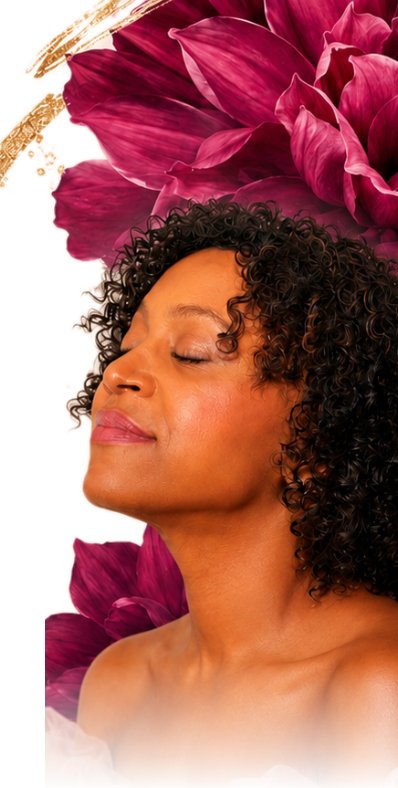
For women deciding to stop being the rock and become the rose.
Save this to Your Phone
iPhone · Safari
Tap the Share icon, then Add to Home Screen, then Add.
Android · Chrome
Tap the ⋮ menu, then Add to Home screen, then Add.
Your EXHALE journey0 of 7 days
A gentle daily nudge
One quiet reminder a day to return to your EXHALE. Private, opt-in, and kept only on this device.
There is a peculiar kind of exhaustion that sleep cannot cure.
It does not originate in the body, although the body eventually begins to protest. It begins in identity.
It is the exhaustion of being the woman who remembers. The woman who anticipates. The woman who notices the empty milk carton before anyone else, who knows which child will forget the permission slip, which parent will need a ride to the doctor, which coworker is struggling, which friend is quietly unraveling. She enters every room already calculating what must be carried.
People call her dependable.
Responsible.
Strong.
She receives these titles as compliments, never realizing that each one quietly increases the weight she is expected to bear.
Yet she cannot remember the last time she belonged to herself.
Then one morning she wakes up and discovers something unsettling.
Her calendar is full.
Her family is functioning.
Her career appears intact.
Yet she cannot remember the last time she belonged to herself.
This guide is not about becoming less generous.
Nor is it an argument against ambition, motherhood, leadership, service, or excellence.
Over the next seven days, you are not being asked to overhaul your life. Radical transformation rarely begins with radical behavior. It begins with radical recognition.
You will notice things that have become invisible through repetition.
You will question assumptions that have masqueraded as virtue.
You will reclaim experiences that were never luxuries but necessities: breathing without urgency, resting without earning it, trusting without controlling every possible outcome.
These are not wellness practices.
They are acts of governance.
At the end of this journey, you will sign your Rose Era Declaration.
Do not think of it as a motivational exercise.
Think of it as constitutional law.
A constitution does not create a nation. It names the principles by which that nation agrees to govern itself.
The woman you are becoming already exists. This week you begin the journey from being everybody’s rock to becoming the rose.
Day One
Breathe
The Woman Who Forgot She Was Alive
There is a question I have been asking myself lately, and it has quietly reordered my life.
Not, What did I accomplish today?
Not, How productive was I?
Not even, Did I make everyone else happy?
The question is far simpler.
How was I alive today?
At first glance it appears almost childish. Of course I was alive. I answered emails, prepared dinner, drove to appointments, solved problems, remembered birthdays, paid bills, folded laundry, showed up for work, and checked another dozen responsibilities from my list.
But existing and being alive are not the same thing.
Many women become extraordinarily skilled at existing.
They become efficient. Reliable. Dependable. Indispensable. They know exactly how long it takes to prepare a meal while answering a phone call, locating a missing shoe, and mentally organizing tomorrow’s meeting. They move through the world with astonishing competence, and because society rewards competence, they rarely question the cost.
Yet somewhere along the way, life becomes administrative.
The days become something to manage rather than something to inhabit.
They stop noticing the morning light through the kitchen window.
They cannot remember the last meal they actually tasted instead of merely consuming.
They pass mirrors without seeing themselves.
They move through their own lives as if they are project managers for everyone else’s existence.
And because they are accomplishing so much, no one recognizes that they are slowly disappearing.
This is why we begin with breath.
Not because breathing is revolutionary.
Because attention is.
Your breath is simply the doorway through which you return to your own life.
Long before the first calendar invitation, before the first expectation was placed upon you, before anyone called you dependable or strong, your body already knew how to breathe without permission. It knew how to receive before it ever learned how to produce.
That matters.
The modern world teaches women to optimize output.
Nature teaches something different.
Every flower opens and closes.
Every tide advances and retreats.
Every season alternates between growth and restoration.
Creation itself is rhythmic.
Only human beings have mistaken constant exertion for virtue.
Perhaps your exhaustion is not evidence that you are failing.
Perhaps it is evidence that you have been attempting to live outside the architecture of creation.
Today, I am not asking you to change your life.
I am asking you to interrupt it.
Three times today, stop wherever you are.
Stand still.
Place one hand over your heart if that feels natural.
Take one slow inhale.
Take one slower exhale.
Then ask yourself a question that may feel unfamiliar:
What do I need in this moment?
Do not answer as a mother.
Do not answer as a wife, daughter, leader, employee, caregiver, entrepreneur, or friend.
Answer as the woman who has quietly accompanied you through every season of your life and whose voice has become almost impossible to hear beneath responsibility.
Listen.
Whatever emerges is not weakness.
It is information.
Today, we are not practicing breathing.
We are remembering that we belong to ourselves before we belong to the world.
Reflection
When did accomplishment quietly replace aliveness as the measure of a good day?
What has my body been trying to communicate that my schedule has repeatedly interrupted?
If I believed that my needs were not inconveniences but instructions, what would I begin noticing immediately?
Today’s EXHALE
“I refuse to confuse survival with living. Today, I choose to be fully alive.”
Day Two
Rest
The Well Was Never Meant To Apologize For Being Empty
There is a dangerous misunderstanding about rest.
Most people imagine that rest is what happens after everything is finished.
After the emails are answered.
After the kitchen is cleaned.
After the children are settled.
After the presentation is complete.
After the guests leave.
After the house is finally quiet.
But there is always another “after.”
The horizon simply moves.
Many women have spent decades living under an unwritten contract:
When everyone else is okay, then I will take care of myself.
It sounds generous.
It sounds noble.
It even sounds loving.
It is also impossible.
Imagine a village whose only well supplies water to every family. Every morning, the people arrive carrying buckets. The well gives freely because that is its nature.
But imagine that no one ever replenishes the land surrounding it. No one protects the soil. No one clears debris. No one notices the slow erosion taking place beneath the surface.
Eventually, the water level falls.
The villagers gather around and begin asking the wrong question.
“What happened to the well?”
The better question is:
“Who believed the source could sustain everyone except itself?”
For many years, you may have mistaken depletion for generosity.
You gave until there was almost nothing left to give.
You wore exhaustion like evidence that you had loved well.
You interpreted constant availability as moral excellence.
Yet nature does not operate this way.
The orchard must be tended before it bears fruit.
The soil must receive before it can produce.
The musician pauses between notes, and the silence is part of the composition.
Even your own heart rests between contractions. If it did not, life itself would become impossible.
Rest is not the interruption of meaningful work.
Rest is what makes meaningful work sustainable.
This distinction changes everything.
Today, I am not asking you to earn rest.
I am asking you to study your resistance to it.
Notice the impulse to justify sitting down.
Notice the voice that whispers you should be doing something more useful.
Notice how quickly guilt arrives when stillness enters the room.
Do not argue with that voice.
Simply observe it.
For years it has mistaken your value for your usefulness.
Today, we are not practicing rest.
We are remembering that creation itself depends upon rhythm, and that nothing beautiful blooms by remaining in perpetual strain.
Reflection
What have I been postponing until I become “less busy”?
Who taught me that my exhaustion was evidence of my goodness?
What parts of my life would become more beautiful if I protected my capacity before my productivity?
Today’s EXHALE
“I am not withdrawing from my responsibilities. I am restoring the source from which I fulfill them.”
Day Three
Trust
The Woman Who Mistook Control for Love
There is an invisible labor performed by women that rarely appears on a résumé and almost never receives applause.
It is the labor of anticipation.
She remembers the dentist appointment before anyone else.
She notices when the milk is almost empty.
She keeps track of birthdays, medications, school forms, family dynamics, emotional undercurrents, and conversations that happened three months ago but may become important tomorrow.
She walks through life carrying an invisible spreadsheet that never closes.
People often call this responsibility.
Sometimes it is.
But sometimes it is fear wearing the clothing of competence.
Somewhere along the way, many women quietly accepted an impossible assignment: If I can anticipate enough, organize enough, fix enough, and carry enough, then everyone I love will be safe.
It is a noble fantasy.
It is also a fantasy.
You were never given dominion over the entire universe.
You were given stewardship over your own life.
There is a profound difference.
Stewardship says, “I will faithfully tend what has been entrusted to me.”
Control says, “I am responsible for outcomes that belong to God, time, circumstance, and other people.”
One produces peace.
The other produces exhaustion.
Consider a gardener.
She waters.
She weeds.
She enriches the soil.
But she cannot command the rose to bloom on Tuesday at precisely 9:17 in the morning.
She participates in growth.
She does not govern creation.
Yet many of us attempt to govern lives that are not ours.
We carry the emotional weather of our adult children.
We absorb the disappointments of our spouses.
We inherit the anxieties of our coworkers.
We replay conversations that ended days ago and rehearse conversations that may never happen.
The mind mistakes vigilance for protection.
The soul knows better.
Trust is not certainty.
Trust is the willingness to participate fully without believing that everything depends upon you.
Perhaps this is why so many capable women are tired.
Not because they have worked too much.
But because they have attempted to hold together worlds that were never theirs to hold.
Today I invite you to make two lists.
The Taxonomy of Stewardship
Mine: My integrity. My health. My words. My choices. My peace. My standards. My becoming.
Not Mine: Other people’s opinions. Other people’s healing. Other people’s expectations. Other people’s timelines. Other people’s reactions. Other people’s happiness.
Look carefully at the second list.
How much of your emotional life has been spent carrying these invisible burdens?
Imagine setting them down, not because you no longer love people, but because you finally love truth.
You cannot carry another adult into wholeness.
You can only walk faithfully into your own.
Today, we are not practicing trust.
We are remembering that the world was never asking us to become its savior.
Reflection
What responsibility have I accepted that was never actually mine?
Where have I confused hypervigilance with love?
If I trusted that life could continue unfolding without my constant management, how would I move differently today?
Today’s EXHALE
“I release what was never mine so that I may faithfully care for what is.”
Day Four
Receive
The Most Radical Thing a Woman Can Do Is Accept Nourishment
There is a sentence many women never say aloud, yet they live as though it were written into law:
“I will take care of myself after everyone else is okay.”
It sounds compassionate.
It sounds selfless.
But over decades it becomes a quiet form of disappearance.
The body understands this long before the mind does.
The shoulders tighten.
Sleep becomes shallow.
Joy feels irresponsible.
Beauty begins to feel unnecessary.
Even receiving a compliment can become uncomfortable.
Someone says, “You look beautiful today.”
And immediately the woman replies, “Oh, this old thing?” “I got it on sale.” “I haven’t even done my hair.”
She deflects the gift.
Not because she lacks gratitude.
Because she has spent years practicing non-receipt.
She receives responsibility.
She receives obligations.
She receives requests.
But she struggles to receive delight.
Nature offers another model.
No flower apologizes for turning toward the sun.
No tree negotiates whether it deserves rain.
No river refuses tributaries because other rivers might need the water more.
Creation understands circulation.
Only human beings interrupt it.
Many women believe giving is the highest moral act.
Yet even giving depends upon receiving.
A candle that is never relit cannot continue sharing its flame.
A well that is never replenished eventually becomes a memory.
Perhaps your life does not require more discipline.
Perhaps it requires more permission to receive what has always belonged to you.
Today, receive something without immediately earning it.
Sit in the beautiful chair instead of saving it for guests.
Light the candle on an ordinary Tuesday.
Wear the good perfume to the grocery store.
Buy yourself flowers.
Accept help without editing it.
Drink your tea while it is still warm.
Allow beauty to enter your life without requiring productivity in exchange.
You may notice resistance.
You may hear an old voice saying, “This is indulgent.”
Smile gently at that voice.
It learned survival in a season when scarcity seemed permanent.
But you are building a different life now.
A woman who knows that nourishment is not extravagance.
It is infrastructure.
Today, we are not practicing receiving.
We are remembering that abundance is meant to circulate.
Reflection
When did I begin believing that everyone else’s needs deserved faster attention than my own?
What gifts have I been declining because they felt undeserved?
If I truly believed that receiving strengthens my ability to give, what would I allow into my life beginning today?
Today’s EXHALE
“I receive without apology, so that I may give without depletion.”
Day Five
Beauty
The Garden Does Not Bloom for the Applause
There is an interesting phenomenon that occurs when women begin returning to themselves.
They buy fresh flowers.
They wear the perfume they have been saving.
They set the table even when they are eating alone.
They replace the chipped mug they have quietly tolerated for years.
They purchase the linen napkins.
They organize the bedside table.
They put on earrings to go to the grocery store.
And almost immediately, someone says, “You don’t have to do all that.”
They are correct. You do not have to. That is precisely the point.
For too long, beauty has been misunderstood as performance.
We imagine beauty exists to persuade, to impress, to attract, or to prove.
But nature tells a different story.
No one applauds the peony when it opens.
The ocean does not wait for spectators before reflecting the sunrise.
The magnolia does not ask whether anyone will notice its blossoms before deciding to bloom.
Beauty is not transactional.
It is expressive.
It is one of creation’s oldest languages.
Somewhere along the way, many women abandoned beauty in the name of responsibility.
The lipstick stayed in the drawer.
The dresses remained in the closet.
The music stopped playing in the kitchen.
The good dishes were reserved for guests who came only twice a year.
The candles waited for an occasion important enough to deserve them.
Meanwhile, ordinary Tuesday afternoons passed without ceremony.
But your life is not the waiting room for a future event.
Your life is the occasion.
There is another misunderstanding worth correcting.
Many women believe that caring for their appearance is vanity.
Yet they think nothing of tending a garden, polishing silver, arranging a home, or restoring a family heirloom.
Why?
Because we instinctively understand that stewardship requires attention.
Your body is also something entrusted to your care.
Your home is not merely shelter. It is your emotional climate.
Your clothing is not merely fabric. It is architecture around the body that carries your life.
Beauty, then, is not consumption.
It is participation.
It is saying to yourself: “I am worth inhabiting well.”
Today, choose one act of beauty that no one else may ever notice.
Iron your favorite pajamas. Arrange flowers from the grocery store in a simple glass jar. Put music on while you cook. Wear the silk scarf. Apply lotion slowly instead of hurriedly. Open the windows. Eat from the beautiful plate.
Do not perform beauty. Practice belonging to it.
The remarkable truth is that women often believe they are decorating their lives when they are actually restoring their nervous systems.
Order quiets the mind.
Light softens the spirit.
Beauty reminds us that existence is more than efficiency.
Today, we are not practicing beauty.
We are remembering that a well-loved life is cultivated, not stumbled upon.
Reflection
When did I begin treating beauty as optional rather than essential?
What ordinary corners of my life have I neglected because I believed no one else would see them?
If my home and my body reflected the same care I give everyone else, what would change first?
Today’s EXHALE
“I refuse to postpone beauty until life becomes easier. I cultivate beauty because I am alive.”
Day Six
Bloom
The Rose Never Asks Permission to Open
Many women believe their greatest fear is failure.
It is not. Their greatest fear is visibility.
Failure can be explained. Visibility cannot.
To be fully seen is to risk misunderstanding.
To be fully seen is to disappoint expectations.
To be fully seen is to outgrow identities that once made other people comfortable.
So instead, many women negotiate with their own becoming.
They make themselves slightly quieter. Slightly smaller. Slightly less ambitious. Slightly less elegant. Slightly less opinionated. Slightly less radiant.
Not enough for anyone to notice. Just enough that they themselves slowly disappear.
This negotiation rarely happens in a single dramatic moment.
It happens through tiny daily concessions.
“I’ll wear that when I lose ten pounds.” “I’ll start the business when life settles down.” “I’ll travel someday.” “I’ll buy the flowers after the promotion.” “I’ll take the picture after I fix my hair.” “I’ll introduce myself differently next year.”
Years pass.
The woman keeps waiting for permission from a committee that does not exist.
Nature offers another lesson.
The rose does not consult the garden before blooming.
It does not ask the tulips whether they approve.
It does not apologize for occupying space.
It simply fulfills its nature.
Blooming is not an act of confidence.
It is an act of obedience.
The world often mistakes visibility for vanity because it has forgotten that every meaningful contribution first requires someone willing to be seen.
Your ideas must be seen.
Your laughter must be heard.
Your gifts must be shared.
Your style must be inhabited.
Your wisdom must be spoken.
Otherwise, the very qualities entrusted to you remain hidden from the people they were meant to serve.
This is not about becoming louder.
It is about becoming truer.
Perhaps the woman you admire is not more talented than you.
Perhaps she simply stopped negotiating with her own visibility.
Today, do one thing as the woman you are becoming rather than the woman you have been rehearsing.
Wear the outfit. Take the photograph. Introduce yourself with conviction. Sit at the front of the room. Post the essay. Say yes. Say no. Speak the idea.
Let your life become evidence that you believe you belong inside it.
Tomorrow, you will sign your Rose Era Declaration.
Do not think of it as a promise.
Think of it as recognition.
The woman signing that declaration is not someone you are hoping to become.
She has been quietly waiting beneath survival all along.
Today, we are not practicing blooming.
We are remembering what creation intended from the beginning.
Reflection
Where in my life have I been asking permission that was never required?
What version of myself have I postponed for the comfort of others?
If I believed I already belonged in the life I desire, what would I do differently tomorrow morning?
Today’s EXHALE
“I no longer negotiate with my own becoming. I choose to bloom, not when I am perfect, but because I am alive.”
Day Seven · The Keepsake
The Rose Era Declaration
Today, I Remember Who I Am
There comes a moment in every woman’s life when she realizes that the life she has been faithfully maintaining is not necessarily the life she was created to inhabit.
Nothing catastrophic may have happened. She may have been successful. Loved. Respected. Needed. She may have fulfilled every role with extraordinary devotion.
And yet, she quietly discovers that somewhere along the journey, she became indispensable to everyone except herself.
For years, I believed that strength meant carrying more. More responsibility. More expectations. More emotional labor. More invisible work. I believed that my ability to endure was evidence of my character.
I now understand that endurance and flourishing are not the same thing.
The tree that survives the storm deserves admiration. The tree that survives and still blossoms deserves stewardship.
Today, I choose stewardship.
I recognize that my body is not a machine but an inheritance. My mind is not a storage unit for everyone’s needs. My home is not merely a place to manage but a sanctuary to inhabit. My life is not an emergency to survive but a gift to cultivate.
I have spent enough years postponing my own existence. No more.
Today, I place the cape down. Not because I love less. But because I finally understand that love without replenishment eventually becomes depletion.
Today, I acknowledge a truth that nature has always known: A river cannot continue flowing if its source is neglected. A garden cannot continue blooming if its soil is exhausted. A rose cannot apologize for requiring sunlight. Neither will I.
This declaration is not a list of intentions. It is the governing philosophy by which I will now live.
Therefore, I Declare
I am no longer available for confusing exhaustion with virtue.
I am no longer available for shrinking to make other people comfortable.
I am no longer available for carrying responsibilities that belong to capable adults.
I am no longer available for performing strength while privately abandoning myself.
I Release
I release the belief that my worth must be earned through usefulness.
I release the guilt of choosing my own restoration.
I release identities that were necessary for survival but no longer serve my becoming.
I release perfection.
I release performance.
I release postponement.
I Reclaim
I reclaim my attention.
I reclaim my energy.
I reclaim my standards.
I reclaim beauty as a daily practice rather than a special occasion.
I reclaim delight without apology.
I reclaim stillness without guilt.
I reclaim my voice before seeking approval for it.
I Choose
I choose to nourish my body because it carries my life.
I choose to protect my peace because it shapes my decisions.
I choose to cultivate beauty because my environment teaches my nervous system what to expect from the world.
I choose to trust that not everything depends upon me.
I choose to believe that receiving is not selfish but sacred.
I choose to become the woman my younger self was waiting to meet.
From this day forward, I will measure my life differently. Not by how much I accomplished. But by how fully I inhabited it. Not by how much I carried. But by how wisely I cultivated my capacity. Not by how often I disappeared for others. But by how courageously I remained present to myself.
One day, people may say that this was the season when everything changed. They will think it happened because I found more time, more money, more confidence, or better circumstances. Only I will know the truth.
Everything changed the day I stopped asking whether I deserved to bloom and remembered that blooming was my nature all along.
Today, I do not become someone else. Today, I return.
I put the cape down. I choose myself. I become the rose.
I am her. ✦ I am whole. ✦ I am becoming.
Sign it · Make it yours
Add your name and keep your Declaration as a framed image, to print, set as your lock screen, or return to whenever the world asks you to be the rock again.
You’ve been the rock.
Sis, it’s time to become the Rose.
If this week stirred something you do not want to set back down, the Rose Era is where it continues: rhythm, confidence, softness, and self-image, rebuilt alongside women who understand exactly what it took to get here.
Rose Era Coaching
For the woman ready to rebuild rhythm, confidence, and self-image with guidance and company. Small cohorts, personal calls, real accompaniment.